
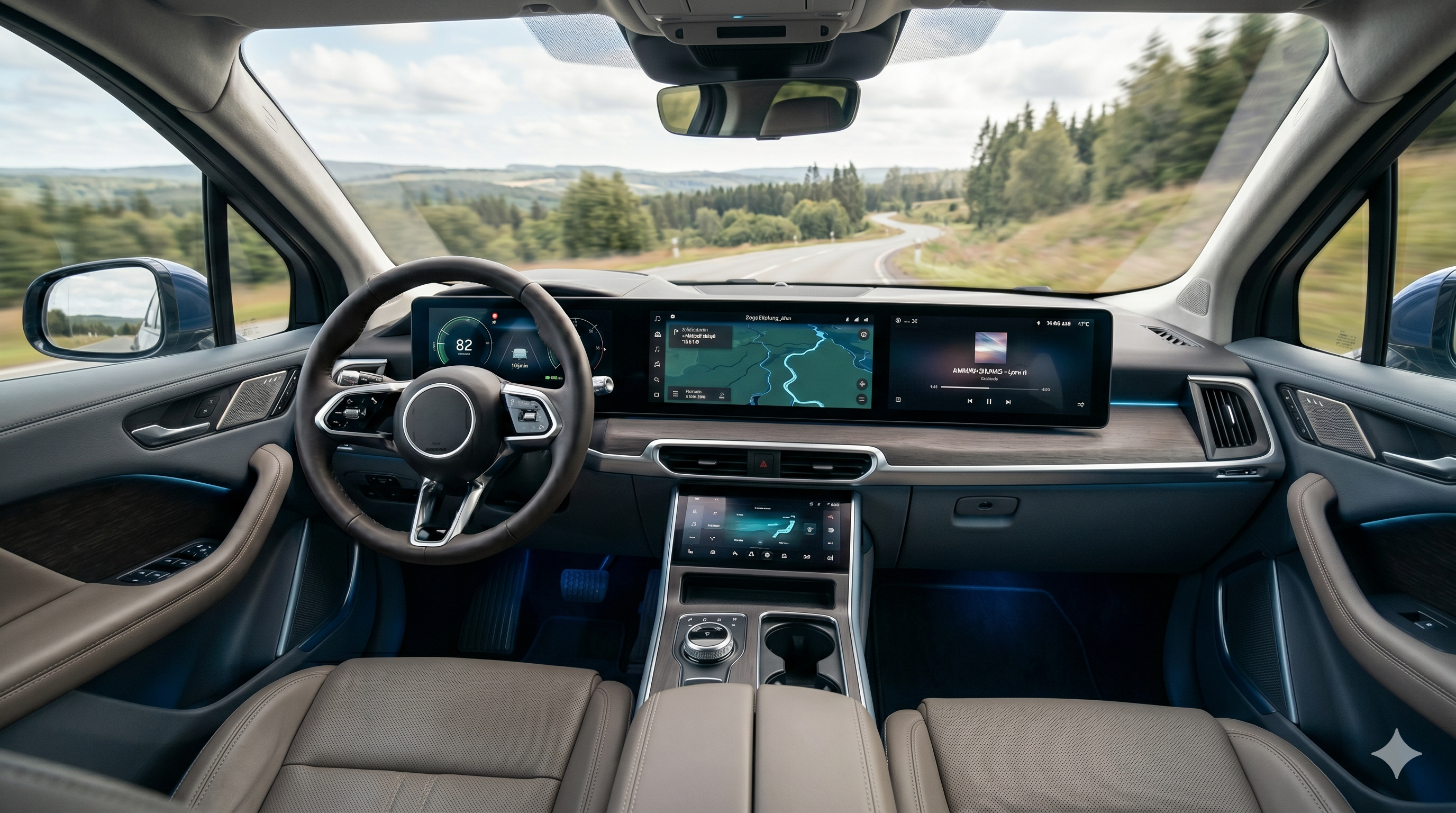
J.D. Power's 2025 Tech Experience Index Study reveals a clear pattern: AI features that learn from real customer signals outperform those built on assumptions. The same logic applies to OEM dealer network AI
There is a pattern buried in J.D. Power's 2025 Tech Experience Index Study that deserves more attention than it has received, particularly for OEM teams thinking about where AI investments go next.
The study, based on responses from 76,230 owners of new 2025 model-year vehicles surveyed after 90 days of ownership, evaluated 40 technologies across five categories. For the first time it included a dedicated smart vehicle category covering seven AI-based features. The results split neatly into two groups: features that customers rated highly and reported few problems with, and features that frustrated them.
The dividing line was not complexity. It was not cost. It was whether the feature actually responded to what the driver was doing.
Smart climate control, smart ignition, and driver preference systems ranked among the top ten across the entire study for both low problem rates and high satisfaction. Smart climate control alone saw a year-over-year improvement of 6.3 fewer problems per 100 vehicles, directly lifting satisfaction scores in J.D. Power's APEAL study. Car wash mode, by contrast, frustrated a third of the drivers who had it. It was buried in the infotainment system, too slow to activate, and poorly explained. Thirty-eight percent of owners said they needed better instructions just to use it.
The difference between those two outcomes is not a design problem. It is a feedback problem.
Features That Learn Versus Features That Assume
Smart climate control works because it observes the driver and adjusts. It picks up on patterns, preferences, and context. Over time it gets more accurate because it has more signal to work with. The driver does not need to think about it. It just gets better.
Car wash mode does not do any of that. It was designed to perform a function, but nobody built a mechanism for understanding whether drivers could actually find it, use it, or trust it. The gap between what the feature was meant to do and what drivers experienced never got closed because there was no loop to close it.
J.D. Power's senior director of user experience benchmarking, Kathleen Rizk, put it plainly: what matters most to vehicle owners, and therefore to automakers, is whether the technology is useful and whether it enhances the driving experience. That is the measure. And usefulness, at scale, across a diverse driver population, cannot be assumed at the design stage. It has to be learned continuously.
The Same Pattern Plays Out Across the Network
The vehicle-level dynamic has a direct parallel in how OEMs deploy AI across their dealer networks.
AI tools designed to personalise communications, predict service needs, or flag at-risk customers perform when they are trained on real, current signals from real customers. When a service reminder is timed based on actual driver behaviour rather than a generic interval, customers respond to it differently. When a follow-up after a service visit reflects what actually happened in that visit, it lands differently to a templated message.
But most AI applications in the dealer network are not working from that quality of signal. They are working from transaction records, CRM fields, and demographic proxies. The experiential layer, what customers actually felt and said about their interactions, is largely absent. The result is the car wash mode problem at network scale. Features and tools deployed with good intentions, built without access to the feedback that would make them genuinely useful.
Recognition technologies in the J.D. Power study illustrated where this leads. Biometric authentication recorded 29.2 problems per 100 vehicles. Touchless controls recorded 19.6. Direct driver monitoring recorded 19.4. These are the technologies with the highest problem rates in the entire study. They are also the most assumption-dependent: they require the system to recognise the driver correctly, every time, without the driver needing to intervene. When the recognition fails, the experience fails completely. There is no graceful middle ground.
The same brittleness appears in AI-driven customer communications that do not account for what individual customers have actually told the brand. A personalisation model that cannot incorporate experiential feedback will, eventually, get the customer wrong in a way that feels worse than no personalisation at all.
What Feedback-Informed AI Actually Changes
The OEMs that will get the most from their AI investments are not necessarily the ones deploying the most advanced models. They are the ones that have built the feedback infrastructure to keep those models honest.
In practice that means structured feedback collected at the point of interaction, tied to specific visits and specific touchpoints, made available to the systems that need it. Not annual surveys. Not aggregated scores published after a six-week lag. Real-time, granular signal that closes the loop between what the AI assumed would happen and what the customer actually experienced.
J.D. Power's findings show that even relatively simple AI features, adjusting a car's climate settings, recognising a driver's preferences, produce measurably better outcomes when they are built to respond to real behaviour. The features that frustrate customers are overwhelmingly the ones that were designed once and not updated.
The dealer network is no different. AI tools built to surface customer insight, route communications, or flag service opportunities perform to the quality of what they are learning from. Closing the feedback gap is not a follow-on step in the AI deployment process. It is the thing that determines whether the investment performs or stagnates.
Manufacturers already investing in network-wide feedback intelligence are building the foundation that makes AI genuinely useful rather than confidently wrong.